
Before choosing
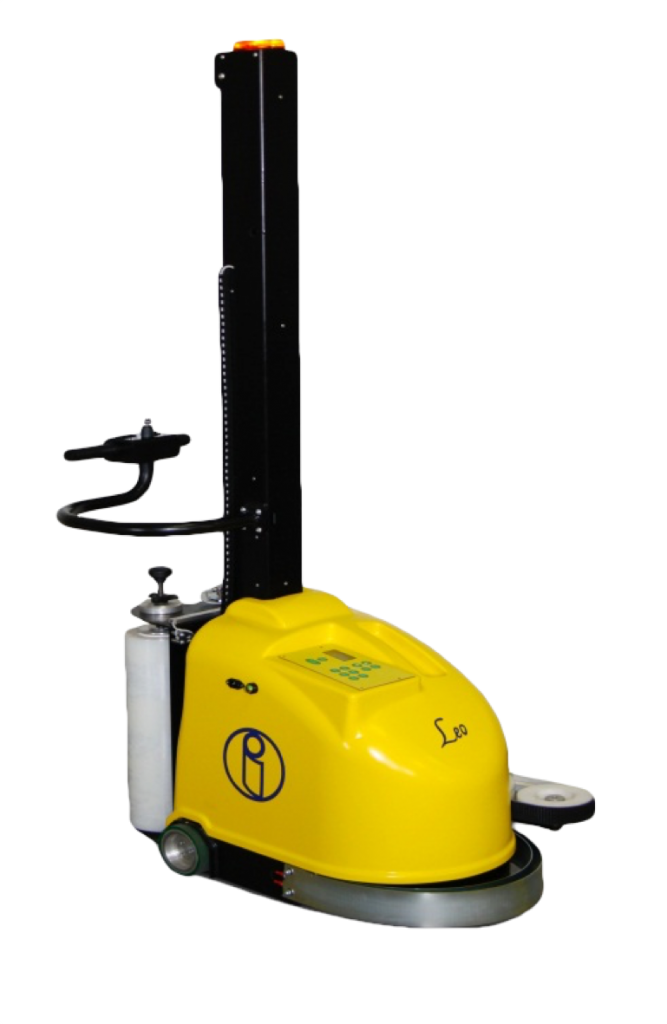
The robot travels to the pallet. The load stays still.
A mobile pallet wrapper is a self-propelled robot that travels around a stationary load and applies stretch film. Consider it when pallets are prepared in several areas, loads are oversized or you want to avoid rotating the product on a turntable. Select the machine for the available working space, floor, load and operating method.
The 75 cm figure applies to LEO and LEONARDO. It is not a specification shared by all robots, particularly the larger LEONARDO SP. During selection, we confirm the configuration and operating conditions of the specific machine.
When does a mobile pallet wrapper make the most sense?
You have no fixed pallet-wrapping station
We primarily recommend robots where a stationary wrapper would be impractical because there is no permanent workstation. If pallets are prepared in different places, the robot can travel to the load, reducing the need to move unsecured pallets to a central point. After a batch, the machine can be parked in the agreed parking and charging area.
A POLPACK ZEUS application example: DIY stores
Mobile robots have proved useful for wrapping pallets in the back-of-house areas and warehouses of DIY stores. Their advantage is the ability to work where the pallet was prepared, without establishing a single permanent wrapping station. This is one application example; similar needs also arise in other warehouses and factories.
You pack large or non-standard loads
The pallet rests on the floor, so its dimensions do not have to fit a wrapper turntable. This does not mean there are no limits: the product outline, height, corners and surface followed by the robot must be checked. We confirm suitability for a non-standard load through a wrapping trial.
You want to wrap without rotating the load
Keeping the pallet stationary can be useful for heavy, tall or movement-sensitive products. Film tension and the wrapping programme still need to be selected correctly: excessive film force can deform packaging or compromise stability. A robot does not replace correct stacking and load preparation.
These are selection examples, not a claim that every robot can handle every product. Watch the robots in operation and explore available configurations.
Compact operation in the warehouse
LEO and LEONARDO: just 75 cm around the pallet
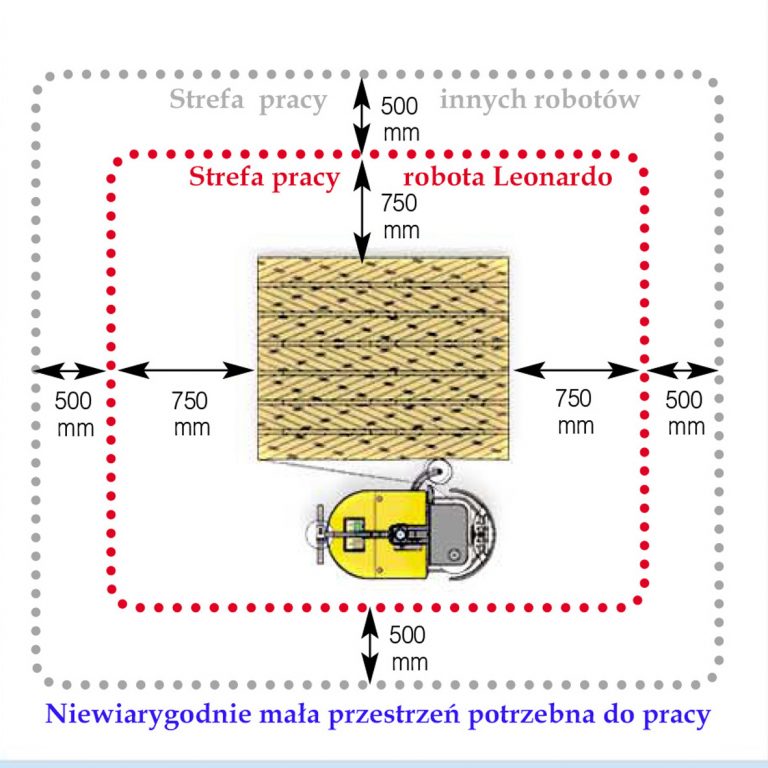
The 75 cm clearance around the pallet is an important advantage of the compact Italdibipack LEO and LEONARDO robots. It makes mobile wrapping worth considering even where a larger robot would require the workstation to be reorganised.
Measure the space around the load
Check the entire pallet perimeter, including protruding packaging, neighbouring pallets, columns, racks and other obstacles. Measuring the aisle at just one point is not enough to assess the workstation.
In addition to the wrapping area, plan access, parking, charging and operator movement. Pedestrian and truck routes are assessed separately; 75 cm is not a specification for traffic-lane width.
LEONARDO SP is a larger design. Its operating requirements must not be assumed to match those of LEO and LEONARDO.
LEO, LEONARDO and larger robots — what should you compare?
We start with the workplace and product, then compare film systems, wrapping height and charging arrangements. POLPACK ZEUS has been Italdibipack's authorised, exclusive partner in Poland since 1992.
| Model | Key feature | What should you check before buying? |
|---|---|---|
| Italdibipack LEO | 75 cm around the pallet. Fixed mast, wrapping up to 2000 mm and a mechanical film brake. Approximately 30 pallets per charge. | Load height and outline, plus film suited to a brake-based system. |
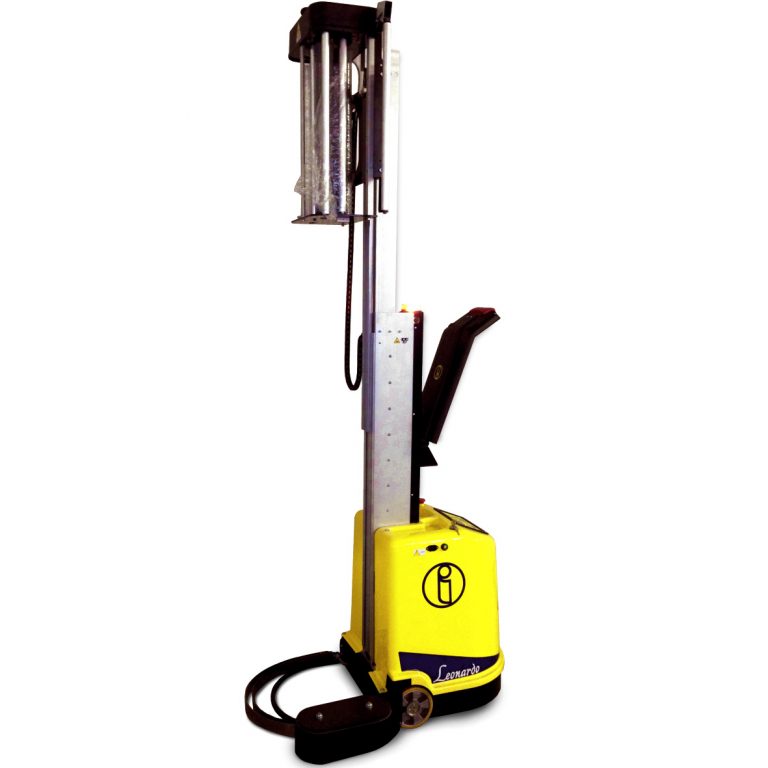
| Italdibipack LEONARDO | 75 cm around the pallet. Telescopic mast, wrapping up to 2350 mm and a powered pre-stretch system. Approximately 30 pallets per charge. | Required height, film-system configuration and tension settings for the product. |
| Italdibipack LEONARDO SP | A larger design to consider for different height and equipment requirements. | A larger working area than for LEO and LEONARDO. The product page provides details of the current configuration. |
| NOXON MAS | A larger robot: approximately 160 pallets per charge. Worth considering when longer operation between charges is a priority. | Additional working space and the performance of the specific version, battery and wrapping programme. |
Indicative figures from POLPACK ZEUS experience: approximately 30 pallets per charge for LEO or LEONARDO and approximately 160 for NOXON MAS. These are not guaranteed results for every cycle or a comparison from a single test under identical conditions. Pallet height, wrap count, travel distance, battery condition and film system affect the practical result. We confirm performance for the selected configuration and the customer's workflow. Do not apply the 30-pallet figure to LEONARDO SP.
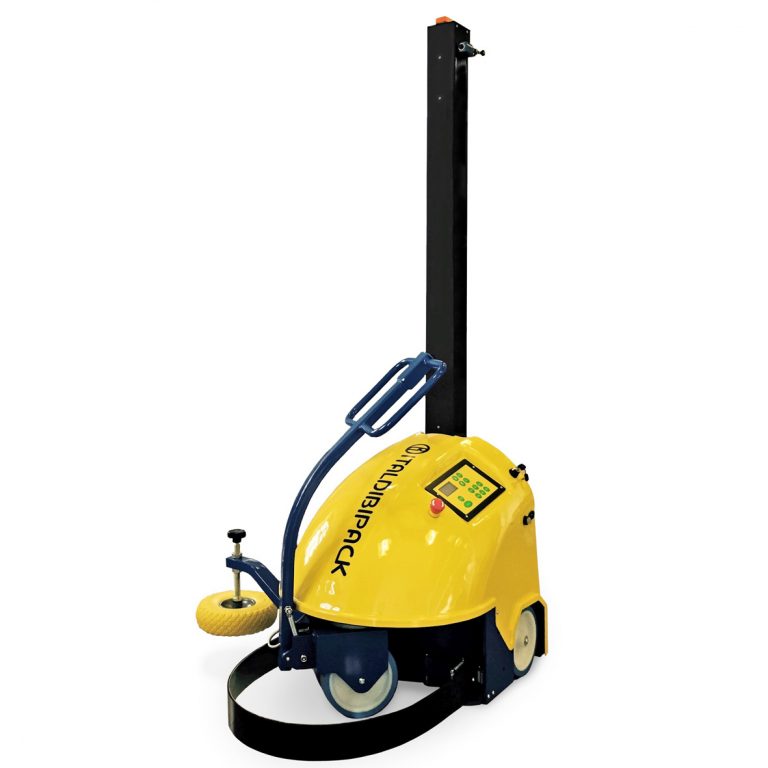
Explore mobile pallet wrapper models, specifications and videos.
When should you choose a stationary pallet wrapper?
If pallets arrive at one station and the machine will be used intensively for years, start by considering Wrapper machines manufactured by POLPACK ZEUS. We select the structure, film system and equipment for the workstation's actual workload. Mobility is valuable when it improves pallet flow at your site.
Choose a mobile wrapping robot
- Pallets are prepared in different places.
- You need to wrap a stationary load.
- There is a clear route around the pallet and a suitable floor.
- You can plan robot operation and charging.
Consider a stationary wrapper
- Wrapping takes place at a fixed, intensively used workstation.
- You want a turntable, top platen or other equipment matched to the process.
- Long service life, maintenance support and parts availability matter.
- You plan conveyor integration — consider Wrapper VO.
Compare Wrapper SE, SA, EVOLUTION, VO and other pallet-wrapping solutions. A rotary-arm wrapper can also wrap a stationary load; a mobile robot is one of the available approaches.
Which stretch film suits a robot? Film brakes and pre-stretch are different systems.
A robot with a film brake
The brake controls unwinding resistance and film tension. It is not a powered pre-stretch system. We select material intended for brake-based operation, including suitable low-stretch films. Film thickness alone does not determine cost or load security.
A robot with powered pre-stretch
The pre-stretch system stretches the film before applying it to the load. The film must suit the system, while stretch and tension must be matched to the product. Powered systems regulate tension independently of pre-stretch, which is particularly relevant for light or easily deformed loads.
During trials, we assess material consumption, pallet stability, film breaks at corners and any packaging deformation. A higher pre-stretch percentage does not replace correct selection of the complete process.
Compare the cost of a secured pallet, not just the price of the robot
Include machine purchase and equipment, film consumption, operator time, travel between stations, roll changes, charging and maintenance. The most useful result is the cost of one correctly secured pallet at the required throughput.
A simple trial measurement
- Wrap a representative batch of identical pallets.
- Measure the weight of film used and divide by the number of pallets.
- Multiply consumption in kg/pallet by the film price in PLN/kg.
- Record the complete cycle time and actual operator involvement separately.
- Compare options only after assessing load security.
Film cost per pallet = film consumption [kg/pallet] × film price [PLN/kg].
Add labour and operating costs to material cost. Machine running time and operator involvement are not always the same. We do not assume a fixed saving percentage; the result depends on the starting point, film and settings.
What should you prepare when selecting a mobile wrapper?
- Load: minimum and maximum dimensions, weight, packaging type, stability and photographs of protruding components.
- Workplace: a floor plan or photographs, clearance around the pallet, access routes, thresholds, expansion joints and floor condition.
- Workflow: pallets per shift and at peak hours, number of workstations, distances and operator availability.
- Film: current material, consumption per pallet and problems you want to resolve.
- Operation: charging location, required runtime between charges, roll-changing method and inspection schedule.
POLPACK ZEUS selects the machine, film and settings, prepares the equipment for operation and trains operators. We also provide service, inspections and spare parts. Trial scope and machine availability are agreed in advance.
Questions before buying a pallet-wrapping robot
Does a self-propelled robot wrap without operator involvement?
It performs a programmed cycle, but an operator prepares the workstation and operates the machine. Film attachment and finishing depend on the equipment; do not assume these tasks are automatic without confirming the configuration.
Does a pallet-wrapping robot transport pallets like an AMR?
No. The robot described here travels around a stationary pallet and applies film. It does not stack cartons or transport loads around the warehouse. Pallet transport is a separate process stage.
How much space does a mobile wrapping robot need?
It depends on the model. LEO and LEONARDO need just 75 cm of clear space around the pallet. Larger robots, such as LEONARDO SP and NOXON MAS, require more room; we confirm this for the selected configuration. Access, protruding load components, floor conditions and traffic arrangements must also be checked.
How high a pallet can LEONARDO wrap?
LEONARDO's maximum wrapping height is 2350 mm. During selection, we check the total height of the prepared load and the machine configuration. LEONARDO SP is a separate model.
Can a mobile wrapper operate on any floor?
Do not assume so. Assess levelness, grip, thresholds, gaps, slopes and obstacles. Confirm permissible conditions for the selected model and workplace.
Is a robot suitable for unstable pallets?
A stationary load is not rotated by a turntable, but film tension still acts on it. Correct stacking, suitable settings and a stability assessment during trials remain necessary.
How many pallets can a robot wrap on one charge?
From POLPACK ZEUS experience, LEO or LEONARDO wraps approximately 30 pallets and NOXON MAS approximately 160 pallets per charge. These are indicative values; results depend on configuration, battery, pallet height, wrap count and travel. During selection, we confirm capability for your duty cycle and establish a charging plan.
Can you use your current stretch film?
Yes, if its properties and roll dimensions suit the machine. We check compatibility with the brake or pre-stretch system, load security and consumption during trials. Changing the film may require adjustments to the settings.
How do you calculate required robot throughput?
Use peak pallet volume, not just the shift average. Measure the full cycle: preparation, film handling, wrapping and travel to the next pallet. Also allow for roll changes and charging in the work plan.
What should you compare with a robot if pallets arrive at one location?
Primarily stationary Wrapper machines manufactured by POLPACK ZEUS. Where the load must stay still, we also assess rotary-arm solutions; for conveyor operation, we consider an automatic Wrapper VO line.
Machine, film and settings
Let's find what will improve wrapping in your warehouse.
Prepare photographs and dimensions of your pallets, the number per shift and details of available space. We will compare a mobile robot with a stationary solution for your workflow.