
PVC, POF or PE? Choosing shrink film and reducing packaging costs
Practical differences between PVC, POF and PE shrink films: clarity, sealing, material yield, Performance 9 µm, PIR/PCR and alternatives such as OLYMPIA Paper.
The best film works with your product and machine
Clarity, gloss and reel price are only the start. Sealing, shrink behaviour, material usage and performance during transport also influence the result. We therefore compare films on the product at a realistic production rate.
In packaging practice, we discuss PVC, POF and PE as three separate commercial groups. POF here means multilayer polyolefin shrink films, commonly based on combinations of polyethylene and polypropylene. PE films are discussed separately as solutions for grouped, transport and specialised packaging.
A practical comparison
PVC DECOTERM offers very high clarity and gloss with forgiving processing. Thicknesses frequently used in our applications are 15 and 18 µm. It is particularly suitable for impulse sealing with a resistance strip, and packs are normally sealed on all sides.
POF combines attractive presentation with material efficiency and formulations for automation. Our common applications use 12–25 µm, often 15 or 19 µm, with Performance available at 9 µm. Correct grade selection matters, and automatic machines with constant-temperature knives can achieve particularly good results.
PE is widely used in our work for robust grouped packs, often at 40, 50 or 60 µm in technical applications. It can form a sleeve-wrapped bundle with open sides or a fully enclosed pack. These thicknesses describe common POLPACK applications, not the entire market or available range.
PVC DECOTERM: gloss and ease of shrinking
In our experience, DECOTERM stands out for very high clarity and strong gloss. It displays the product well and is relatively easy to seal and shrink. Its tolerance of setting variations can be useful on simpler machines.
We particularly recommend considering it for impulse sealing on chamber machines and semi-automatic L-sealers with tunnels. It can produce an attractive result even where control over hot-air circulation is limited.
Applications include bread, biscuit cartons, cosmetics and suitable candle and memorial-candle packaging. Clean sealing elements, correct settings and workstation ventilation remain necessary.


POF: make the most of the machine
Polyolefin offers attractive packs and a range of formulations for general packaging, fast lines and demanding products. Compared with DECOTERM, achieving the best result often requires more precise sealing settings and uniform air circulation.
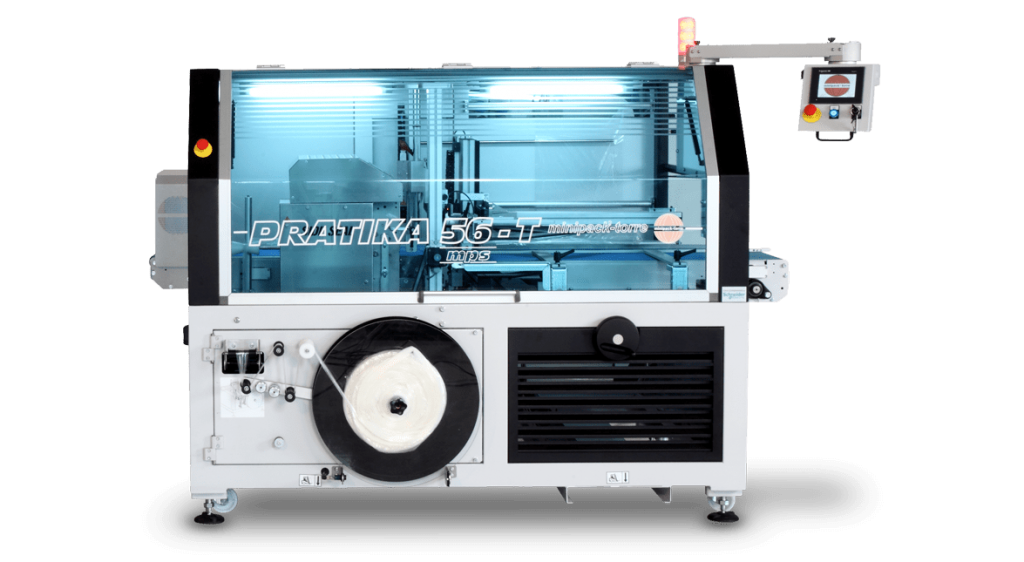
Stable constant-temperature knives, a repeatable cycle and a well-selected tunnel help realise this potential. POF can also run on a chamber machine, but the choice of grade is especially important in that case.
Airflow, tunnel dwell time and perforation all affect shrinking. Raising temperature alone does not solve every problem. For delicate cartons, shrink force must also be selected to avoid deformation.


Performance 9 µm: less material for the required job
We offer five-layer Performance 9 µm films for high-speed packaging processes. In suitable applications they can replace conventional 15 µm POF. The aim is to retain pack quality while using less film, increasing reel length where reel specifications permit, and reducing reel changes.
The comparison covers the finished product, seal strength and reliable running at the target speed. These checks establish the actual saving; film thickness alone does not.
A cheaper kilogram does not always mean a cheaper pack
PVC may cost less per kilogram, but equal masses of different films do not necessarily provide equal areas. Density and thickness both matter. Compare cost per square metre or per acceptable finished pack rather than price per kilogram alone.
The same principle applies when comparing conventional POF with thin Performance film. Reel length depends on thickness, width, film mass, core and maximum reel diameter. The film name alone does not determine the number of metres.
Illustrative calculation: with the same pack area and film density, reducing thickness from 15 to 9 µm reduces film mass by 40%. If the thinner film costs 30% more per kilogram, its material cost is 0.60 × 1.30 = 0.78 of the starting cost: 22% lower. This is an example, not a price quotation or guaranteed saving. It assumes comparable waste and successful replacement, with rework and downtime also assessed in trials.
PE: strong grouped packaging and specialised options
In our applications, PE is most often used for grouped bottles, cartons and larger or heavier products. It is available as flat film, centre-folded film and tubing, selected for the machine and pack closure.
Typical technical PE films can appear hazier than PVC and POF, but this is not true of every PE grade. Raw materials, formulation and manufacturing technology can improve gloss and clarity. A specialised grade is worth discussing when PE packaging needs a better presentation.
Among the typical materials we compare at POLPACK, DECOTERM PVC stands out for clarity and gloss, followed by presentation-oriented POF and then technical PE. Appearance should nevertheless be judged on the actual samples.

Why do water multipacks have open sides?
Strong PE film can form a bundle with cross seals before and after the product, leaving open sides after shrinking. Water and milk multipacks are familiar examples. The openings may help handling, but the way a bundle is carried must suit its construction and weight.
PE can also be fully sealed where greater protection from dirt is required. PVC and POF are normally used in more fully enclosed packs. Seal quality and perforation determine protection: sealing around the product does not automatically create a hermetic moisture barrier.
Virgin material, PIR and PCR
Virgin material is plastic not made from recyclate. PIR means post-industrial recycled material recovered from manufacturing waste. PCR means post-consumer recycled material recovered from products after use.
PE films can be made from virgin material or contain recyclate. In our POF offering, POLPACK currently focuses on established PIR formulations, including grades with 30% PIR. The exact content and permitted applications come from the specification of the selected material.
Recycled content and direct food contact
PCR requires particular attention to the origin of the material and possible contamination. Suitability depends on the requirements applicable to the recycling process, finished-film documentation and intended food-contact conditions. Neither the PIR nor PCR abbreviation is itself approval for every food application.
Food-contact suitability, recycled content and compliance with applicable PPWR requirements must be supported by documentation for the specific grade.
Recycling: check the actual collection route
In Poland, handling cross-linked films can be considerably more difficult. POLPACK's experience with waste collection partners indicates limited opportunities to accept and process these materials. Confirm the route for the particular grade before making a selection.
A PE-based construction can help align packaging with an appropriate recycling stream, but the whole pack must be considered, including labels, printing and additives. A film being non-cross-linked, or being called POF, does not automatically establish full recyclability.
Compostable films and OLYMPIA Paper
We offer compostable formulations that can replace PP, PE or POF in suitable applications. Selection considers closure, protective properties and the stated composting conditions. Industrial compostability is different from home compostability; biodegradability is not a substitute for either specification.
OLYMPIA Paper is paper without a film laminate, closed using heat-activated adhesive. In selected applications it can replace a POF or PE pack. The paper does not shrink like film: the form of packaging changes.
A new machine is not always needed. POLPACK's technical team can assess an existing flow wrapper or suitable Hugo Beck configuration. We have experience selecting settings and modifications, checking paper handling, sealing, output and product protection.
Compare materials on your own product
Bring the current film, machine model, product dimensions and required result. We can agree a showroom trial or a test on your line to assess appearance, material consumption, seals and reliable operation.
Cooling, sharp edges, stacking and handling also matter. The objective is the lowest justified material consumption while retaining the protection your product needs. Our separate shrink-wrapping guide explains sealing technology, operator workflow and total process costs in more detail.
Explore related guides
Fruit and vegetable packaging: machines, films and complete packing linesPackaging bread, biscuits and cakes: machinery, films and takeaway packagingShrink wrapping: how to choose the machine, film and processEgg packaging: from trays and shrink film to secured pallets
Try packaging with your own product
Discuss your product, output and packaging requirements with our team and arrange suitable trials.