
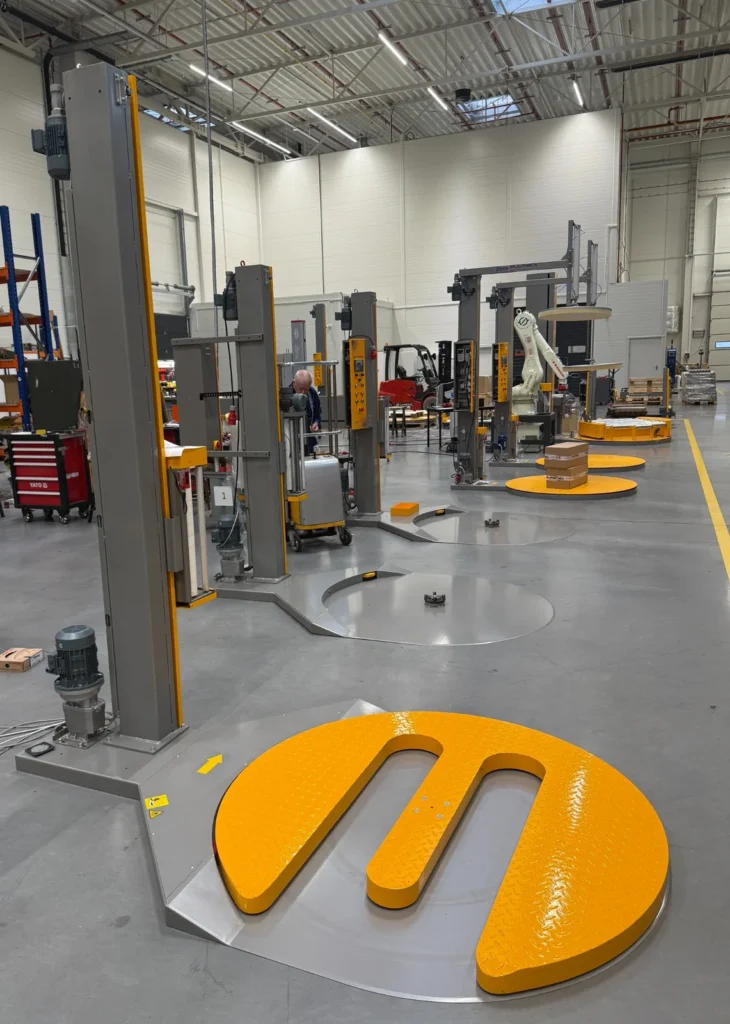
Wrapper pallet wrapping machines are designed and manufactured by POLPACK ZEUS. We combine robust construction, industrial control components and custom engineering with support from the manufacturer after purchase. These machines secure palletised loads with stretch film. For users, what matters is reliable dispatch, stable loads and a machine that can be maintained for years to come.
That is what we mean by lasting quality and peace of mind. Our experience includes machines still working at customer sites after 20 years. Correct selection, operation, inspections and repairs all contribute to a long working life.
Key points
What makes a pallet wrapping machine durable?
Durability depends on more than brochure specifications: the frame, turntable support, drive selection, sensors, cable protection and serviceability all matter. Attention to these details is standard across the Wrapper range manufactured by POLPACK ZEUS. Here we use our own photographs to explain specific design choices and what they mean in everyday operation.
Explore Wrapper pallet wrapping machines and configurations →
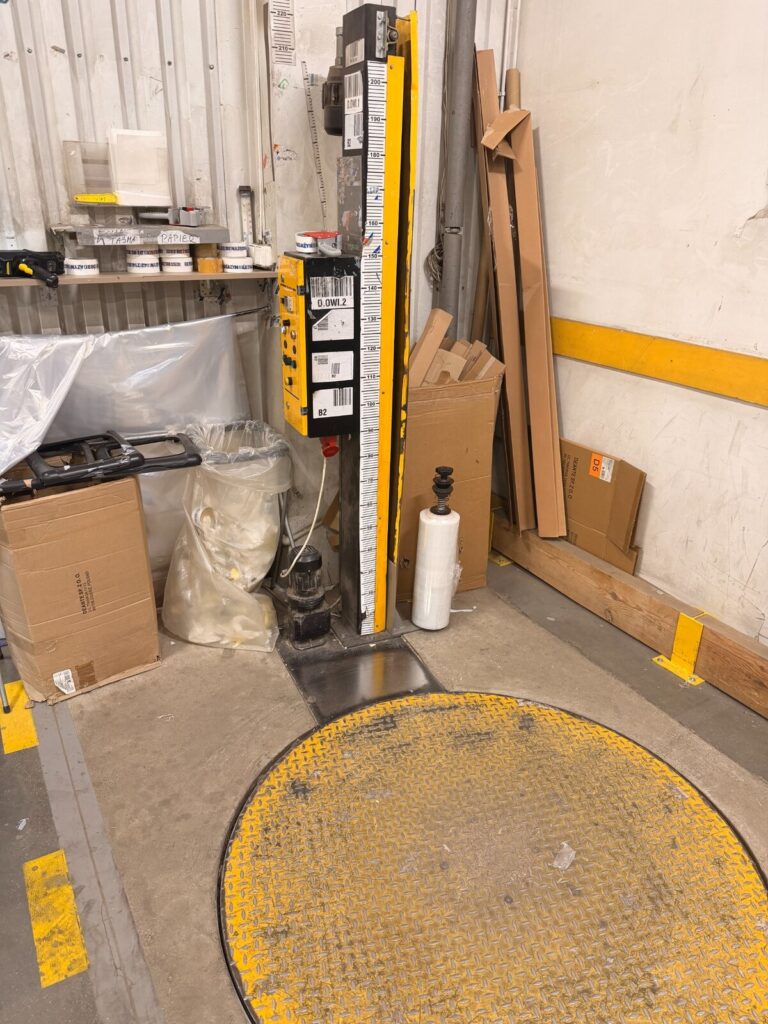
A robust frame designed for years of work
Every Wrapper model is built around a rigid steel structure with a design margin for its intended working loads. This also applies to standard machines. For particularly heavy or unusual loads, we design additional reinforcement and select the other assemblies accordingly.
Steel sections and structural assemblies are selected for each model. The base, mast, joints and turntable support work together to carry loads through repeated cycles. Their rigidity helps keep interacting components correctly aligned.
For a facility regularly wrapping heavy pallets, this means a structure suited to repetitive work. For custom machines, we assess the whole system, from the base and supports to the drives and loading method.
Construction details / 01
Mast cross-section: rigidity and stability
Robust steel construction is standard in every pallet wrapper we manufacture. Models differ in functions and equipment, but not in our approach to quality. Cross-sections, wall thicknesses and joints are selected for the intended loads and duty.
These photographs compare the masts of two machines. The measured folded-sheet component on the other manufacturer’s machine is under 2 mm thick; the measured POLPACK component is over 4 mm. With comparable geometry, thicker walls increase rigidity and reduce deflection. Together with the cross-section and joint construction, they support stability and durability through repeated cycles.
This is a tangible construction difference that programme counts and turntable diameters do not reveal.
See another view
Close-up of the edge and fold in the same structure.
See another view
The actual cross-section of a POLPACK wrapper mast.
POLPACK measurements were taken on the coated components shown. Wall thickness, cross-section and joint construction work together to provide rigidity.
POLPACK ZEUS · In practice
What is beneath the pallet wrapper turntable?
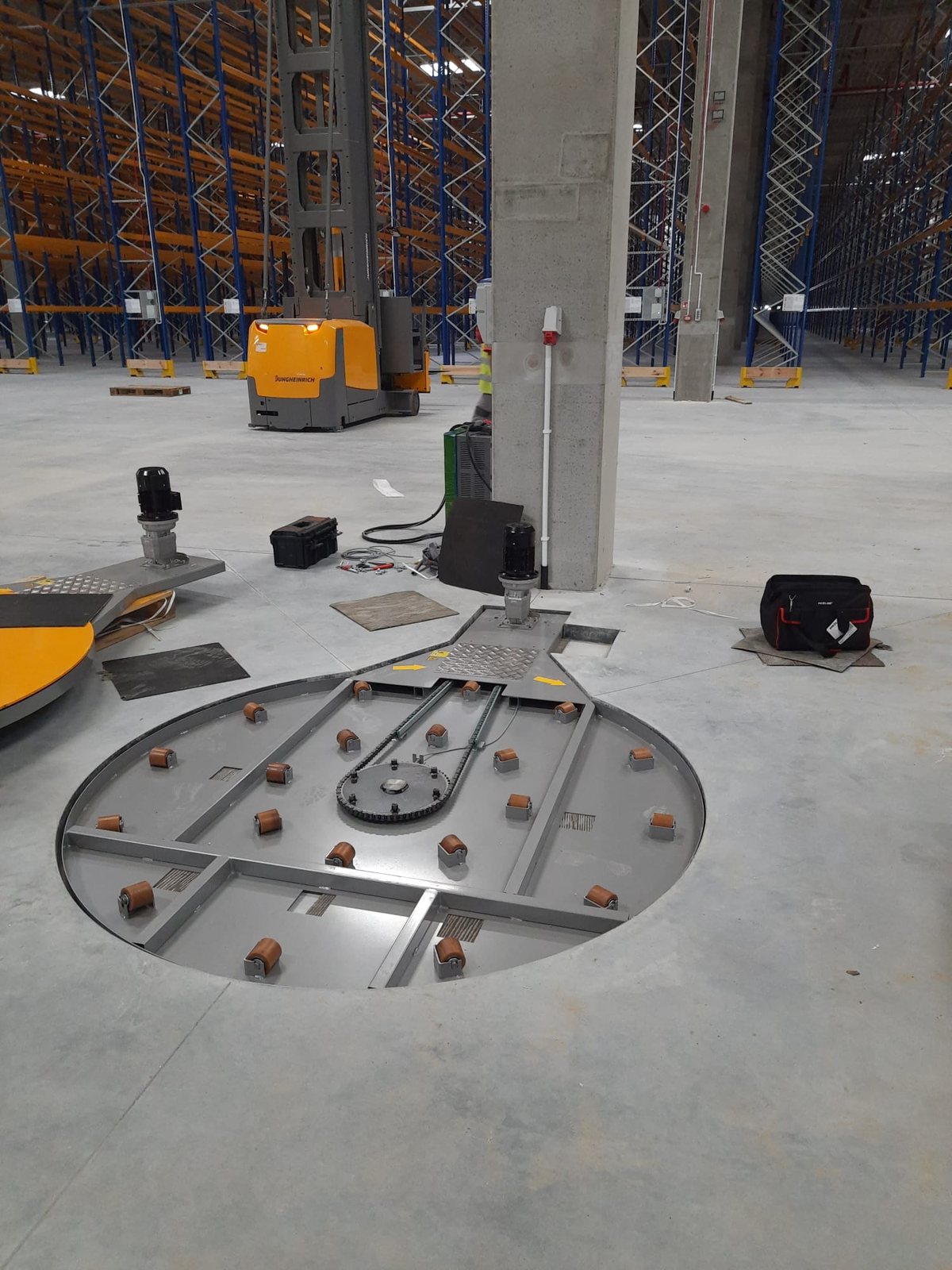
Rated load capacity is one factor when selecting a pallet wrapper. The frame, the arrangement of turntable support points and the drive system also deserve attention. Some budget machines may have only eight support rollers despite a higher stated maximum pallet weight. Roller number and layout should nevertheless be assessed alongside turntable diameter, frame construction and load distribution.
Build quality, finish and safety
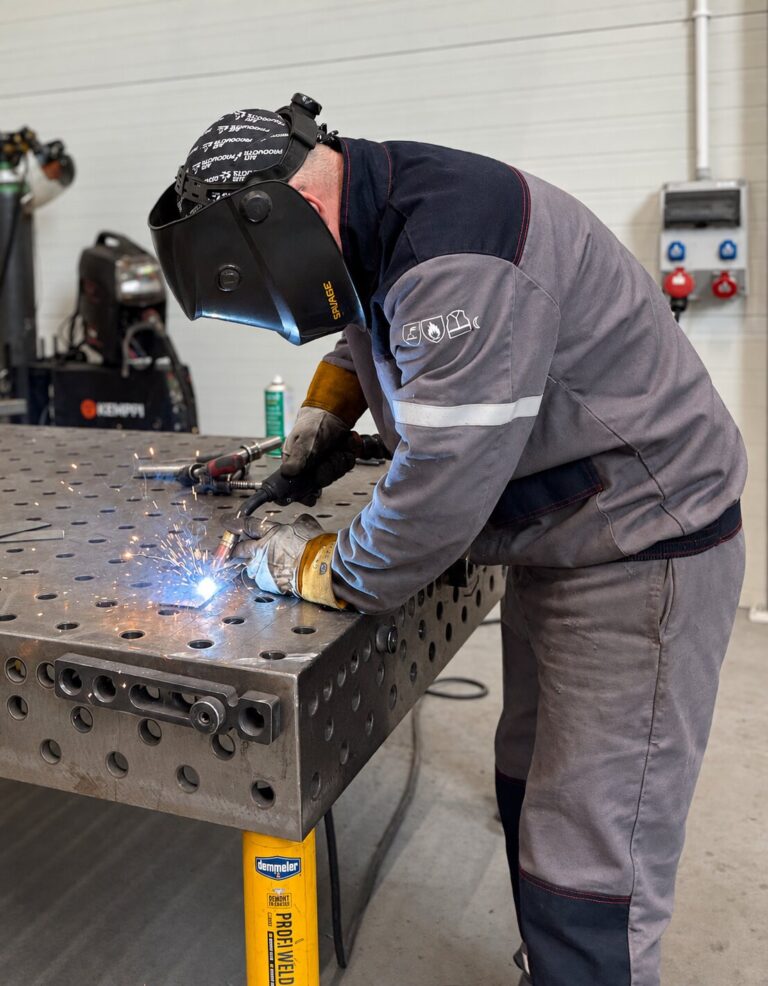
We pay attention to the build and finish of the whole machine, including details encountered by operators and service technicians every day. Careful assembly, well-designed guards and orderly cable routing are part of a professional pallet wrapper’s quality.
Our pallet wrappers are designed to meet the safety requirements and applicable standards for their construction and intended use. Protective measures are selected for the operating method and workstation. In custom projects, safety is considered alongside mechanics, controls and workflow.
The structure, assembly quality and appropriate safeguards form a complete package, supplied with documentation and the agreed commissioning arrangements.
Construction details / 02
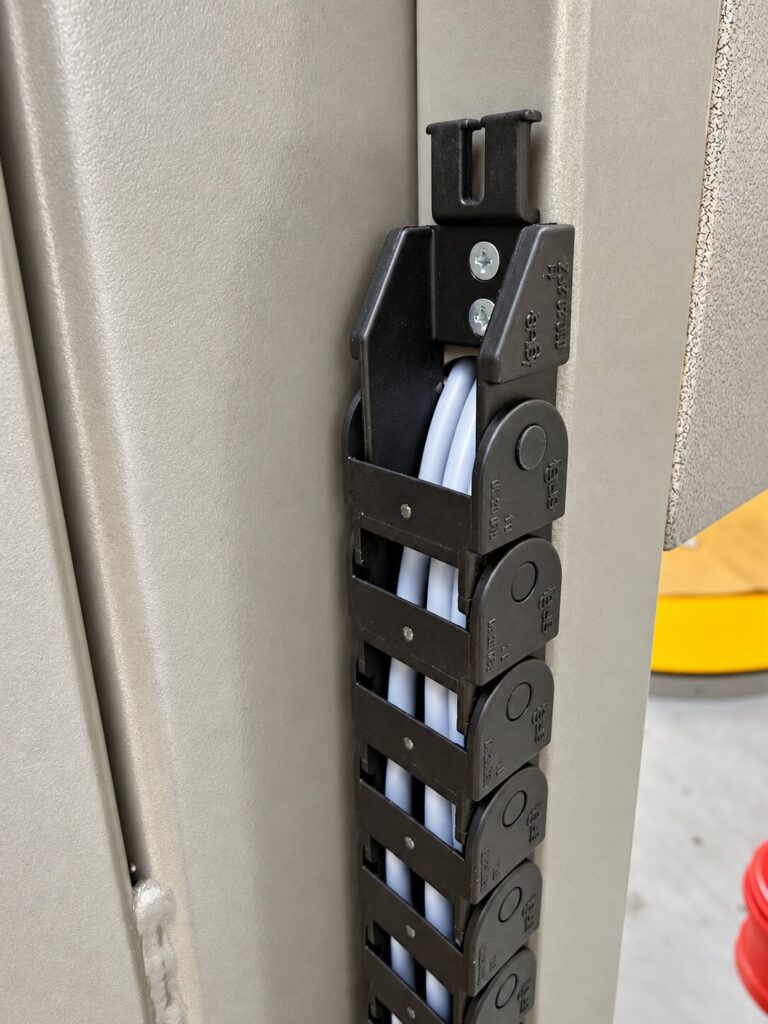
Cables inside the base: protection near the drive
Both photographs show the inside of a wrapper base. In the other manufacturer’s example, cables and connections have no additional metal protection at the location shown. Our design routes cables through metal protective tubes, controlling their path and protecting vulnerable sections.
This routing reduces exposure to accidental contact with mechanical components, abrasion and damage during handling. Protecting the installation is part of our manufacturing standard, rather than simply an optional extra.
See another view
Close-up of cable protection beside drive components in the POLPACK base.
Metal protective tubes shield vulnerable cable sections and keep their routing organised inside the machine.
Replaceable control components: repair the affected part
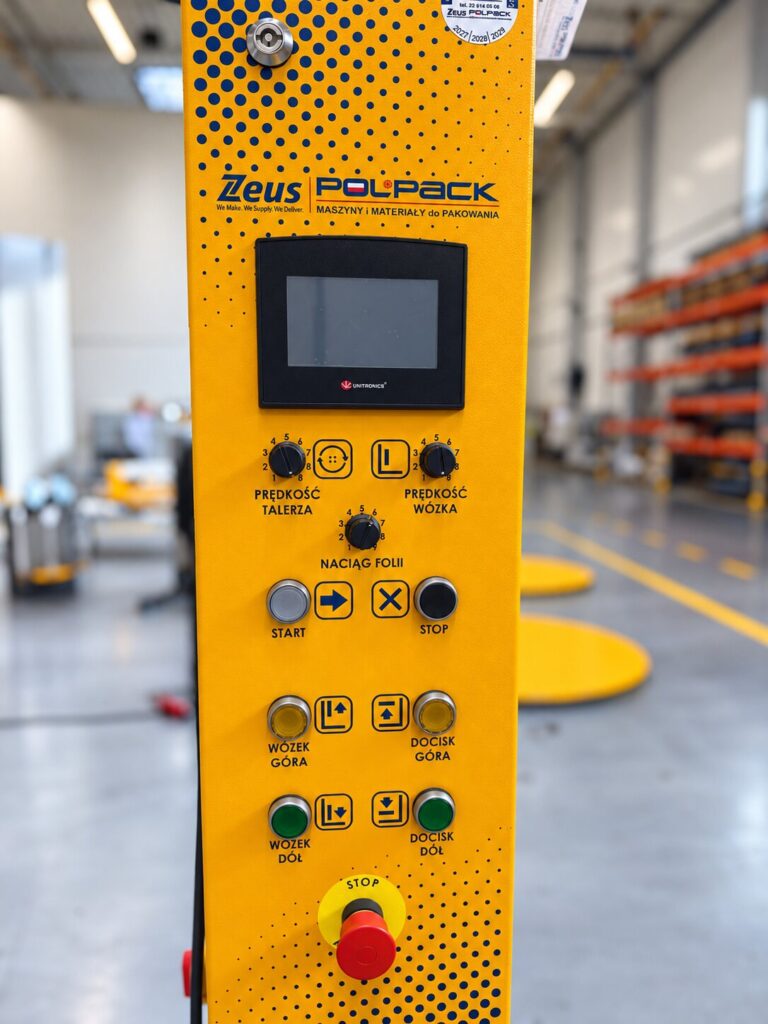
Wrapper control systems use identifiable industrial components that can be diagnosed and replaced as separate assemblies. Depending on the model and configuration, these include Unitronics or Siemens controllers and Weintek operator panels. Automation is selected to suit the machine’s functions and configuration.
This differs from a system that combines many functions on a proprietary electronic board made specifically for one machine manufacturer. If that board fails, repair options and replacement supply may depend on the availability of that exact version. When comparing quotations, check which components can be replaced separately and where they can be sourced.
One failed component need not mean replacing the entire control system
For example, if diagnostics identify a faulty separate inverter or power supply, that component may be replaced while retaining the working controller and operator panel. This limits the scope of replacement and gives the service team a clear starting point for sourcing parts.
Replacing individual components remains a practical advantage of Wrapper machines after years of use. Ask not only whether service is available, but what would need replacing in a typical fault and who manufactures the component.
How does control-system design affect repairs?
Serviceability depends on the level at which a faulty element can be replaced. In the Wrapper shown, a separate inverter, power supply or pushbutton component can be replaced while keeping other working parts. Where functions are integrated on a proprietary board, the work may involve repairing the electronics or replacing that board.
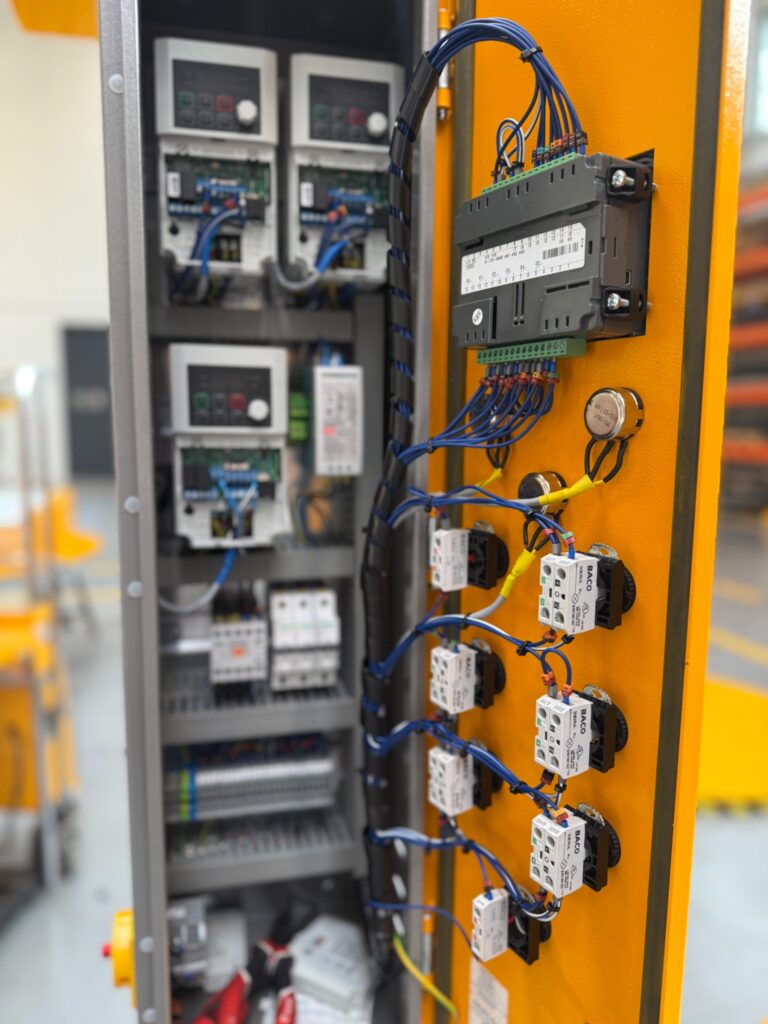
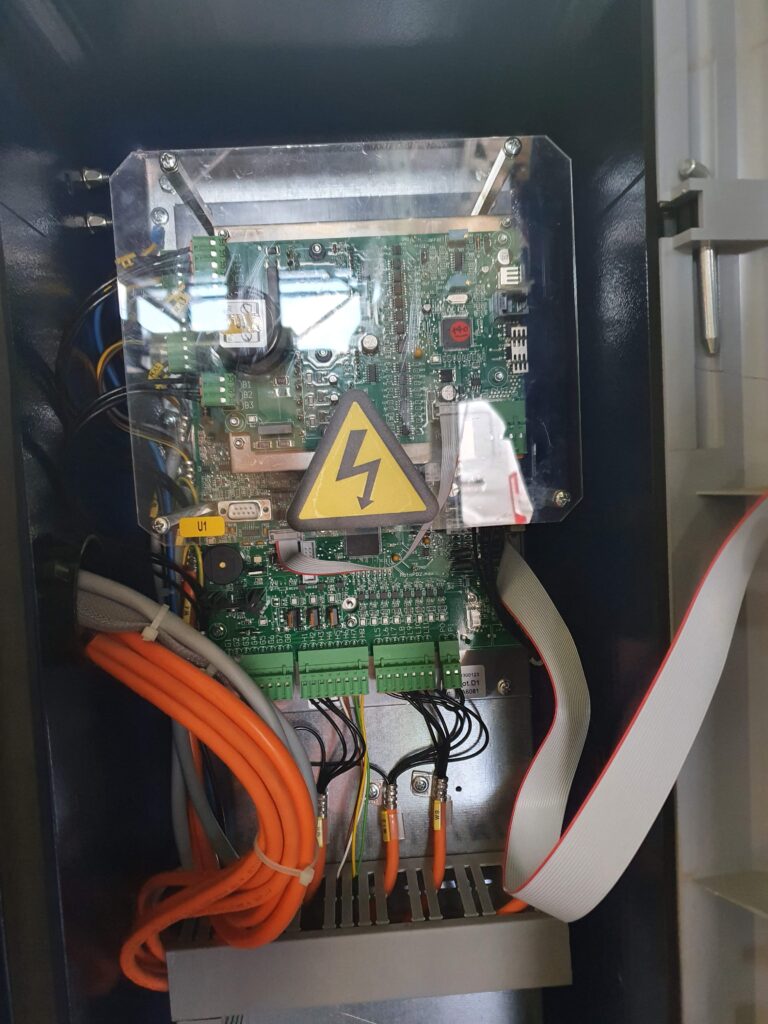
Replaceable industrial components make a practical difference: a faulty assembly can be repaired or replaced separately, with a clear route to identifying the required part.
| Service question | POLPACK Wrapper — separate components | System with a proprietary board |
|---|---|---|
| What is replaced after a fault? | Following diagnosis, a faulty separately mounted component, such as an inverter or power supply, can be replaced. | A fault in a board-integrated function requires assessment of electronic repair or replacement of the correct board. Separate components may still be replaced individually. |
| How are parts sourced? | Identify the industrial component’s manufacturer and model. Availability can be checked with POLPACK and automation distributors. | Establish the compatible board version and its availability through the service channel. Similar appearance does not establish compatibility. |
| What can be arranged before a failure? | An agreed stock of selected components and replacement arrangements can be based on the machine’s configuration. | Establish the board number and version, repair or replacement route, required software and lead time in advance. |
For Wrapper users, this means repairs can be planned around specific, identifiable components. Our machine documentation and knowledge of its configuration help our service team select parts and plan work. Recovery time depends on diagnosis, parts availability and the configuration required.
Construction details / 03
Inductive sensors: no mechanical contact wear
The first photograph shows a mechanical limit switch with a lever and roller — a solution also used in other manufacturers’ wrappers. Activation requires physical movement of the actuator.
We use inductive sensors for positioning functions in our wrappers. They detect metal without touching it with a lever or roller. The sensor therefore has no mechanical switching mechanism or contacts subject to that type of wear.
This removes one component-wear mechanism during repetitive cycles. Correct sensor selection, installation and adjustment remain important for reliable positioning.
Non-contact sensing removes the mechanically actuated lever and roller from this positioning function.
Unitronics, Siemens and Weintek: identifiable parts and support routes
An industrial component has a manufacturer, model number and documentation. Unitronics, Siemens and Weintek maintain their own distribution and support channels. Service teams can identify the device and check the wider automation supply market instead of relying solely on electronics specific to one machine.
This makes it easier to plan repairs, organise spare parts and prepare maintenance. For a critical dispatch station, suitable spare components can be agreed in advance. Sourcing need not begin only after the machine stops.
Replacing a controller or operator panel also requires the right software and configuration. This is where POLPACK ZEUS matters as the manufacturer: we know the Wrapper configuration and can define the work required. Buying the device alone is not enough to restart the machine.
If a component is discontinued, options include a service spare, compatible replacement or upgrade. We assess these using the component documentation and knowledge of the individual machine.
A modular system may still use devices combining several functions, such as a PLC with an HMI. What matters is which assemblies are replaceable and what documentation and support routes are available.
5 or 80 pallets a day? Very different use after three years
Machine age means little without its cycle count. Assuming 250 working days a year:
| Pallets per day | Cycles per year | Cycles in 3 years |
|---|---|---|
| 5 | 1 250 | 3 750 |
| 30 | 7 500 | 22 500 |
| 80 | 20 000 | 60 000 |
Two three-year-old wrappers can differ sixteenfold in completed cycles. Each cycle brings more starts and stops, turntable revolutions and film-carriage movement. At higher volumes, selecting the frame, drives and supports for repetitive duty becomes increasingly important.
Before buying, define the expected cycle count and working conditions. This helps match the machine to its actual workload over the coming years.
Wrapper configurations can be selected for the workstation’s expected duty. In intensive use, structural margins and suitable components matter in every cycle.
Your busiest hour matters too
Thirty pallets spread across a shift and thirty pallets waiting just before a lorry arrives are different tasks. Daily averages can hide periods of continuous operation.
We therefore ask about peak pallets per hour, loading and unloading times and shift patterns. Workstation throughput includes the operator’s tasks: turntable speed alone does not determine finished pallets per hour.
When production outgrows a single workstation, consider more automation, including a Wrapper VO automatic pallet wrapping line. Selection should reflect both the current workload and the agreed growth plan.
Load capacity and structural design margin
| Model | Maximum pallet weight |
|---|---|
| Wrapper SE | 1600 kg |
| Wrapper SA | 2100 kg |
| Wrapper SA E | 1500 kg |
| Wrapper VO | 1600 kg |
| Wrapper EVOLUTION | 2100 kg |
These figures apply to standard configurations. All Wrappers are designed with a substantial structural margin for their intended working loads. Reinforced machines can be supplied on request, with permitted pallet weight specified for the individual configuration. A design margin supports durability within the rated range; it does not increase the permitted load stated in the machine documentation.
Wrapper’s rated load capacity is selected for regular operation, with a substantial structural margin. We assess the whole machine through repeated loaded starts, rotations and stops. Moving one heavy pallet once does not show how a wrapper will perform over thousands of cycles.
Pallet weight and dimensions, load distribution, cycle frequency and loading method all matter. Structural reserve supports durability in the intended conditions. The load limit in the individual machine’s documentation remains binding. For heavier pallets, we select an appropriate configuration.
Multi-point turntable support
Our turntable wrappers use multiple rubber-coated support rollers to distribute the load across several points. Their arrangement is selected together with base and turntable stiffness for stable, smooth operation with the intended load.
When comparing machines, look beneath the turntable: check the support arrangement, roller positions and the entire assembly. These are important details for frequent wrapping of heavy pallets.
Construction details / 04
Drives for pallet-truck-access turntables — one photograph, two examples
One photograph compares drives used in two pallet wrappers with the same declared pallet load capacity and an E-type turntable with pallet-truck access. At the top is the drive from the other manufacturer’s machine: a 0.55 kW motor with a worm gearbox. At the bottom is the assembly used in our Wrapper machines: a 0.75 kW motor with a cylindrical gear reducer.
The same declared load capacity does not mean the same drive design. For the same pallet load rating, Wrapper uses a 0.75 kW motor and a cylindrical gear reducer, compared with the other machine’s 0.55 kW motor and worm gearbox. This is a deliberate part of our approach to engineering with a design margin for everyday operation and repeated starts under load.
Careful industrial-drive selection is standard across our wrapper range. The assembly shown is one specific configuration. Motor size and rated power alone do not determine durability: gearbox selection, permissible torque, loading conditions, cycle count and maintenance also matter.
Quiet, smooth everyday operation
Quiet operation is one of our pallet wrappers’ characteristics. Rubber-coated turntable support rollers and well-matched assemblies promote smooth movement. This is especially valuable to people operating or working beside the machine throughout a shift.
During a demonstration, listen to a complete loaded cycle: starting, rotation and stopping. This helps assess running behaviour under conditions close to your application.
Light pallets also need the right machine
A low weight does not always make wrapping easy. Film tension can pull a light pallet across the turntable. Product deformation or movement is a separate concern.
A top hold-down can help in some applications, but not every load can tolerate pressure. Fragile products or their geometry may rule it out.
In suitable Wrapper configurations, we use additional measures to improve grip between the pallet and turntable and reduce movement during wrapping. These are combined with appropriate film tension and movement settings. We test the solution with the actual pallet and product; better grip at the base does not replace an assessment of the whole load’s stability.
This can justify a custom configuration even at low pallet volumes. The customer needs an effective way to wrap a difficult product, not simply higher throughput.
Film stretch and tension: stable loads with less material
| Model | Available systems | Stretch and tension |
|---|---|---|
| SE | Mechanical or electromagnetic brake | Tension adjustment without powered pre-stretch. We recommend a suitably selected low-stretch film. |
| SA / VR | Multi-roller carriage with a mechanical brake, multi-roller carriage with an electromagnetic brake, or single-motor powered pre-stretch | The powered version uses a fixed stretch ratio selected within 150–280% to suit the load and film, with independent tension adjustment. Brake versions do not have powered pre-stretch. |
| E EVOLUTION | Two-motor powered pre-stretch | Continuously adjustable stretch up to 300%, with independent, continuous tension adjustment. |
Pre-stretch elongates the film between powered rollers. Tension determines the force applied to the load. In powered systems, tension is adjusted independently of stretch. Film selection and settings are verified through trials to reduce wrapping cost while achieving the required load protection.
We select the film system to achieve the required load stability with as little material as practical. Stretch means film elongation; tension is the force the film applies to the load. Both must suit the product, film and wrapping process.
Fragile loads require different film handling from rigid, heavy packs. Wrapper therefore offers several stretch and tension-control systems, depending on the model and task. Trials with actual pallets assess protection, film consumption and repeatability.
Does powered pre-stretch always pay?
Not always. A powered pre-stretch system should be justified by the particular process. At high volumes, lower film consumption can significantly reduce costs. At low volumes with suitable film and a straightforward load, another system may deliver the required result with lower purchase and maintenance costs.
A choice of systems allows us to compare technical and economic suitability: load stability, film consumption, cycle count and purchase and operating costs. Even at low volumes, a difficult product can justify more advanced control.
A simple example illustrates why material use matters: PLN 0.30 saved per pallet × 80 pallets per day × 250 working days = PLN 6,000 per year. This is an illustrative calculation. Actual cost differences and payback are established from trials and the facility’s own data.
Stainless-steel configurations: full or mixed, as required
In demanding applications such as food processing, the description ‘stainless-steel wrapper’ does not define the entire specification. Check fasteners, chains, bearings, motors and gearboxes too.
Adaptation to the operating environment
Where the facility requires a full special configuration, we adapt the whole machine to the agreed environmental requirements. This includes stainless-steel bolts and chains, and appropriately selected bearings, motors and gearboxes. Components are selected for the operating conditions and cleaning method; they do not all require the same material or protection.
This includes internal parts that are not visible in a photograph but are essential to operation. Compare the complete specification. Suitability must be confirmed for the site’s moisture, cleaning chemicals and washing method.
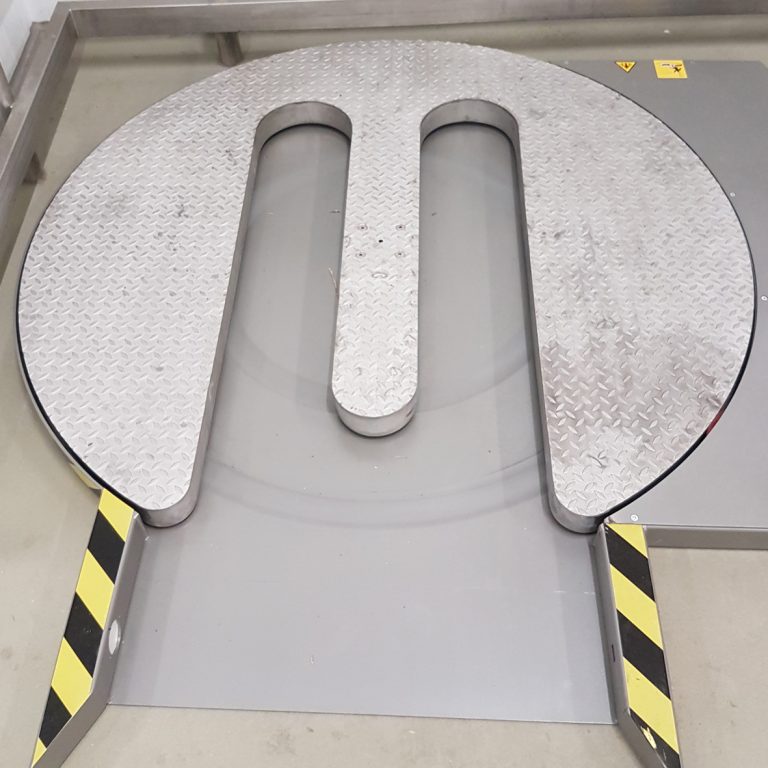
Stainless-steel E-type turntable with standard remaining assemblies
Not every food-industry application requires an entirely stainless-steel wrapper. We often use a mixed configuration: a stainless-steel E-type turntable with a standard base and other assemblies. This is appropriate where the stainless-steel requirement concerns food-contact elements and working conditions permit standard construction elsewhere.
A mixed configuration can substantially reduce cost compared with a fully adapted machine. The scope is based on actual product contact, hygiene requirements and cleaning methods. The photograph below shows a stainless-steel E-type turntable; its base is not stainless steel.
Downtime costs more than a spare part
At low volumes, a stoppage may mean temporarily wrapping by hand. With many loads, it can create pallet queues, require more staff and delay dispatch. Whether a backup workstation is available also matters.
Before buying, ask about component availability, fault diagnosis and repair scope. Modular controls may allow a faulty component to be replaced instead of a larger assembly. Compatibility and configuration must still be checked by the service team.
In-house production and service
We document every wrapper before dispatch
We record the machine configuration and its components. Subsequent servicing can therefore refer to the actual machine specification, including individually engineered units.
This helps identify parts, plan repairs and assess upgrades. Customers can speak to a team familiar with the machine’s construction.
Wrapper machines also use shielded cables to help limit electromagnetic interference. Electrical installation and service access are part of the design, alongside the visible mechanical structure.
The mast, drive, sensors, cable protection and replaceable assemblies influence how a machine is operated and maintained over time. Our photographs show specific construction differences worth assessing alongside price and headline specifications.
High-quality construction and components are standard across all pallet wrappers manufactured by POLPACK ZEUS, not reserved for the most advanced model.
Custom pallet wrappers for unusual tasks
We also engineer highly customised pallet wrappers for individual facilities. Customisation can include load capacity, machine geometry, turntable size, wrapping height, a ramp for the customer’s pallet truck, top hold-down, film system or environmental adaptation.
We build configurations for very heavy loads, for example 5,000 kg, with appropriately designed structures, supports and drives. If your project involves pallets weighing 8,000 kg or other unusual requirements, contact us about a custom project. The solution and specifications are defined after assessment.
Longer or reinforced ramps are selected for the specific truck’s geometry, clearance and loads. Assembly and commissioning are carried out by a team familiar with our machines. Anchoring and workstation preparation follow the documentation and floor conditions.
In-house manufacturing also lets us assess later adaptations or upgrades as products and workflows change. You can discuss requirements with a team that knows your wrapper’s construction and configuration.
Workstation functionality
Pallet-truck-access turntable: three starting positions
An E-type turntable has a cut-out for loading with a manual pallet truck without a ramp. In Wrapper machines with this turntable, two sensors in the base work with the controls to position it and select one of three turntable starting positions. The operator selects the position on the panel to suit front or side loading.
This helps organise the workstation: loading direction can be accommodated in machine settings rather than dictating the whole workflow. Available functions are confirmed for each configuration.
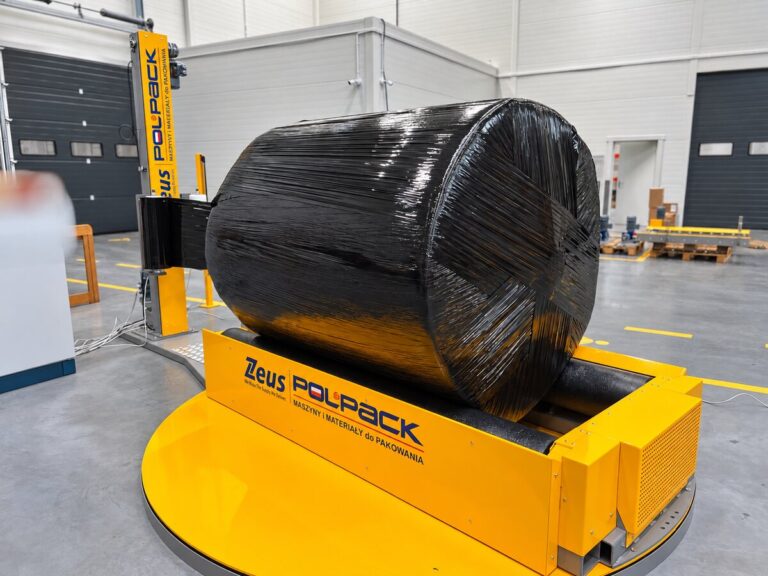
Custom project: a wrapper for 2-tonne bales
Unusual products also require an appropriate method of rotation. In this project, the machine was designed for large bales weighing 2,000 kg. The bale rotates during wrapping so stretch film can cover its entire surface, including the ends. This is a solution designed for a specific load and packaging result.
Five-year warranty and inspections: support after purchase
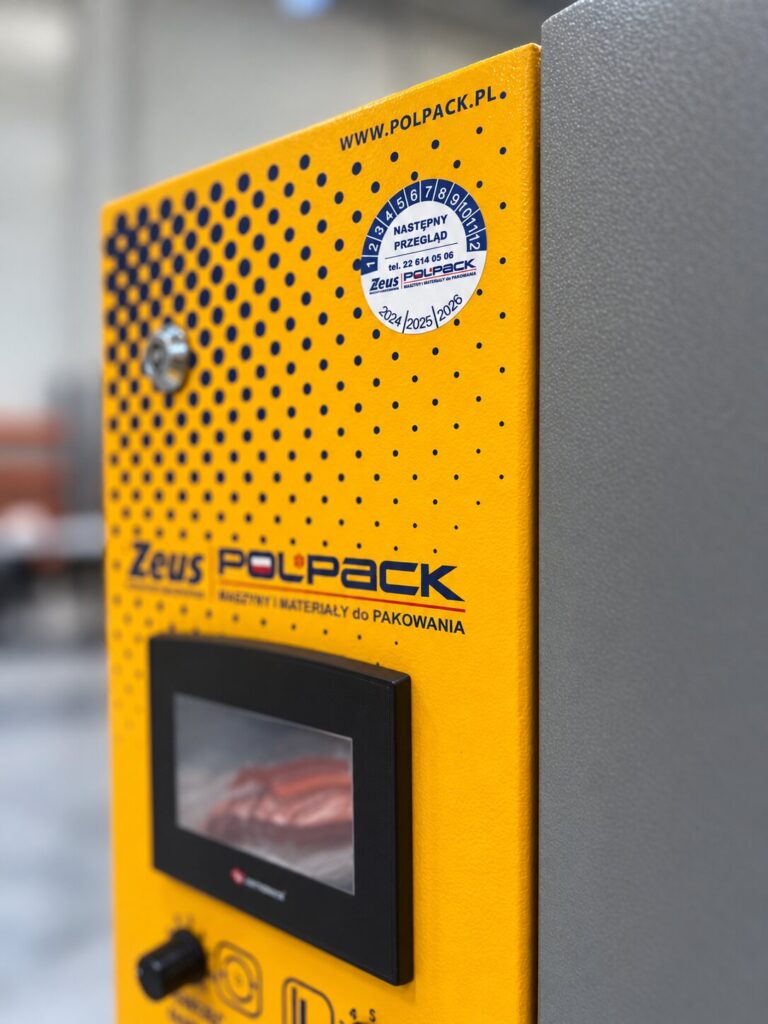
Selected Wrapper models and configurations are offered with a five-year warranty, subject to annual inspections and the warranty terms. Cover, inspection arrangements and costs are specified in the individual quotation and warranty documentation. For overseas installations, confirm warranty eligibility, service coverage, the inspection provider, travel costs and parts arrangements for the destination country before ordering.
An inspection can identify adjustments, corrections and maintenance needs, allowing issues to be addressed and work planned. Confirmation of readiness for continued operation is provided where the inspection findings and completed work support it.
For larger organisations, this also provides a documented reference for maintenance and workplace safety teams. An inspection record helps document the checks carried out and maintain a service history. It relates to the machine’s condition and the scope checked on that date; it does not replace ongoing user responsibilities or other required inspections.
Compare not just the warranty length, but who will inspect the machine, understand its configuration and document the work over subsequent years.
POLPACK ZEUS pallet wrapping machine production is covered by an ISO 9001:2015-certified quality management system. This concerns the organisation of production processes, separately from the warranty and service terms for an individual machine.
Ask about warranty terms and inspection arrangements.
What do you gain by choosing a Wrapper pallet wrapping machine?
Long-term peace of mind has practical foundations: a robust structure with a design margin, replaceable components and access to the manufacturer that knows your machine.
- A durable working platform: rigid steel construction, multi-point turntable support and assemblies selected for the intended loads.
- Operator comfort and safety: quiet operation, careful workmanship and safeguards suited to the design and application.
- Selection for actual needs: equipment matched to duty, heavy or light pallets and unusual products.
- A justified film-system choice: assessment of load stability and material consumption, including alternatives to powered pre-stretch.
- Repairability over time: industrial control components, individual machine documentation and manufacturer support.
- After-sales support: five-year cover for eligible configurations and inspections documenting machine condition, under the agreed terms.
- Manufacturer flexibility: special configurations, including stainless steel, and individual assessment of adaptations and upgrades.
How do we match a pallet wrapper to your needs?
| Your requirement | What do we select and check? |
|---|---|
| Regular wrapping of many heavy pallets | Rated capacity, structure, supports and drives suited to weight, cycle count and peak duty. |
| Light pallets that cannot use a top hold-down | Pallet-to-turntable grip, film tension and movement settings, tested on the actual load. |
| Load stability with lower film cost | Stretch and tension system and wrapping programme; comparison of material use and the economics of available options. |
| Unusual weight, dimensions or loading method | Custom construction, reinforcement and workstation equipment following an assessment. |
| Moisture or special cleaning requirements | Full or mixed special construction, including adaptation of internal components to site conditions. |
| Stoppages block dispatch or production | Service arrangements, documentation, component repairability and an agreed spare-parts stock. |
Pallet count is only one selection criterion. Even a few difficult loads can justify custom engineering. We consider the product, duty, environment and workstation together.
If the pallet must remain stationary or you need a mobile workstation, also consider self-propelled pallet wrapping robots (in Polish). A robot travels around the load; selection considers available space, the floor and pallet characteristics. This is a workflow-driven alternative, whose construction, service and film system deserve equally careful assessment.
Solutions for straightforward tasks too
POLPACK ZEUS also offers economical machines such as the Italdibipack EcoSpir EV (in Polish). These may suit a few standard pallets a day in normal warehouse conditions, where the available configuration meets the requirements. This is an application example, not a throughput limit for the model.
Where regular intensive duty, difficult loads, custom construction and long-term manufacturer support matter, explore Wrapper. Selection considers the workstation and complete equipment specification, rather than purchase price alone.
Polish-made pallet wrappers working across Europe
Our machines are used in Poland, Scandinavia and the Baltic states, as well as Spain, England, Ireland, Iceland, Ukraine, Czechia, Slovakia and Greece. POLPACK ZEUS wrappers also operate in Icelandic fish processing.
Experience from different facilities informs our selection of structures, equipment and special configurations: from daily warehouse dispatch to environments requiring individually adapted machines.
Questions before buying a pallet wrapper
Can a Wrapper pallet wrapping machine work for 20 years?
Some customer machines are still operating after 20 years. This is documented operating experience, not a guaranteed service life for every unit. Durability depends on loads, environment, operation and maintenance. We combine robust construction with repairability and service support.
How many pallets per day justify considering a wrapper?
Regularly wrapping dozens of pallets is a good reason to compare configurations designed for intensive work. There is no fixed threshold: weight, cycle requirements, dispatch peaks and downtime cost also matter.
Can a light pallet require a special configuration?
Yes. If the pallet moves during wrapping and a hold-down cannot be used, suitable Wrapper configurations can combine better turntable grip with appropriate film settings. Results are assessed on the actual load.
Do all stainless-steel wrappers have the same specification?
No. Options include a fully adapted machine or a mixed configuration, such as a stainless-steel E-type turntable with standard remaining assemblies. Selection depends on product contact and site conditions. Compare frame and fastener materials, chains, bearings, motors, gearboxes and permitted cleaning methods.
What do annual pallet-wrapper inspections provide?
They are a condition of maintaining five-year cover for eligible configurations under the warranty terms. They identify adjustment and maintenance needs. Following a satisfactory inspection and required work, readiness for continued operation can be confirmed within the scope checked. Overseas service and inspection arrangements must be agreed for the destination.
What is the benefit of industrial control components?
They help identify parts, diagnose faults and replace individual assemblies. Depending on configuration, we use Unitronics or Siemens automation and Weintek panels. Parts availability is checked for the model; replacement may require the machine manufacturer’s software and configuration.
How should I compare Wrapper with other professional wrappers?
Compare equivalent configurations: frame construction, automation, replaceable components, film system, environmental specification and commissioning. Include warranty terms, inspections and after-sales support.
Is powered pre-stretch always the best choice?
It is not always economically justified. We match the system to pallets, film and workload, comparing load stability, material consumption and purchase and operating costs. Different systems allow selection for actual needs.
Does a structural margin permit exceeding rated load capacity?
No. A design margin supports durable operation at the intended load. The capacity stated in the machine documentation applies. Heavier pallets require an appropriately selected or engineered machine.
Can a wrapper be ordered for an unusual pallet?
Yes. We design configurations for heavy weights, unusual dimensions, light loads and special environments. Send the requirements, pallet dimensions and weight, and a description of the workstation so we can assess the solution.
Do similar brochure specifications mean identical construction?
No. Similar load capacities, turntable diameters or programme counts do not mean the same build. Compare the mast, turntable supports, drive, sensors and cable protection too. This article illustrates such differences using specific machines.
Does a larger motor automatically mean a more durable wrapper?
No. Motor power and size are only part of the assessment. Gearbox selection, loading, cycle frequency and maintenance also matter. We compare complete drive assemblies, not just the power on a rating plate.
Explore the Wrapper range
Wrapper SA pallet wrapping machine · Wrapper E EVOLUTION pallet wrapping machine · Pallet wrapping machine — Wrapper SE · Automatic pallet wrapping lines — Wrapper VO
Need a pallet wrapping machine? Talk to the manufacturer
Have an unusual load or requirements a standard machine cannot meet? Contact us. We design pallet wrappers for specific tasks. Together we can define the structure, film system and workstation equipment.
Tell us daily and peak-hour pallet volumes, weights and dimensions, product type, the pallet truck used and workstation conditions. Load photographs and a film sample help us select the machine and agree a trial.
We will match a Wrapper model, equipment and commissioning scope to your production. Explore our pallet wrappers, our guide to pallet wrapper purchase costs and 20 questions before choosing a machine (in Polish).
Let’s choose a wrapper for your pallets →
About the photographs and comparisons
Photographs and measurements: POLPACK ZEUS. Our own technical documentation shows the construction details discussed in this article.
Photographs have been cropped and lightly adjusted for tone and sharpness, without generating or altering technical components. Further technical reference: OMRON — how non-contact proximity sensors work.