
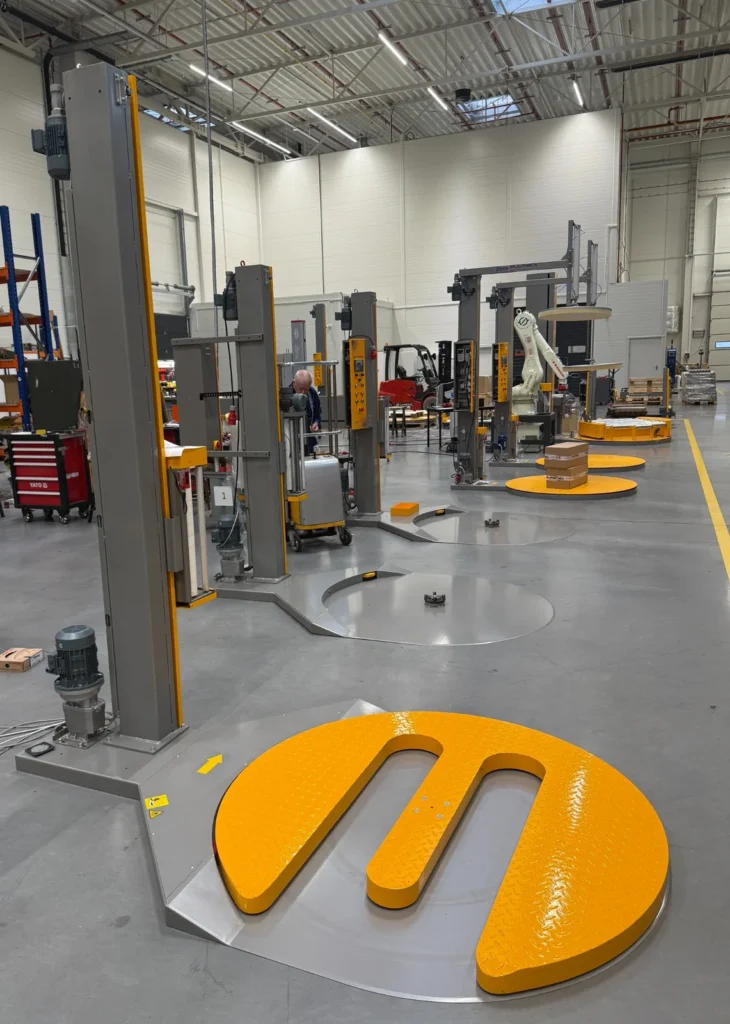
What changes when you introduce a pallet wrapper?
A pallet wrapping machine helps control film consumption, repeat a proven wrapping pattern and reduce manual wrapping. The greatest value comes from combining a machine suited to your pallets, the right stretch film and a tested wrapping programme.
It is a process improvement you can measure through material cost, handling time and the consistency of pallets prepared for dispatch.
| Area | What does a wrapper provide? | What should you measure? |
|---|---|---|
| Film | Control of stretch, tension and wrap count. | Grams and film cost per pallet. |
| Operator | Less walking around the pallet with a roll and applying film by hand. | Actual hands-on time per pallet. |
| Consistency | A repeatable wrapping programme for each load type. | Wrapping quality across successive pallets. |
| Dispatch | A workstation matched to peak workloads. | Pallets per hour, including handling and transport. |
Use film where it adds value
With manual wrapping, it is easy to add extra layers just in case. A machine lets you set the number of bottom and top wraps, film overlap and tension. Material consumption becomes a controlled process parameter.
A pre-stretch system stretches the film before applying it to the load. Suitable stretch and tension settings help make effective use of the material and match the wrapping force to the product. The aim is a stable load with efficient film use.
The film matters too: its properties, compatibility with the pre-stretch system and behaviour on your load. Start with a trial on your own pallets, then weigh the film used. Talk to us about selecting stretch film.
Measure the cost of a secured pallet
Compare the result, not just the roll price
Film cost per pallet = film used in kilograms × price per kilogram. For the complete process cost, add operator time, machine running and maintenance costs, and any rewrapping.
Repeatable load securing
A saved programme helps reproduce the settings for successive pallets of the same type. Bottom and top reinforcement, the wrapping sequence and tension can be adjusted. This is especially useful when different operators share a workstation.
Load stability starts with correctly stacked goods. Film works together with the pallet, outer packaging and other securing measures. During a trial, check corners, protruding items and whether packaging can tolerate the wrapping force.
Less manual wrapping and better work organisation
Hand wrapping involves carrying a roll around the load, bending and reaching its upper sections. A wrapper takes over film application, reducing these activities.
Operator involvement depends on the solution. With a typical semi-automatic machine, the operator positions the pallet, attaches the film, starts the programme and completes handling after the cycle. Automatic film attachment or cutting can remove further tasks. A fully automatic line also incorporates pallet transport and integration with other equipment.
Compare hands-on operator time and complete cycle time separately. Turntable rotation time alone does not describe workstation throughput.
Handle the busiest dispatch hour
Average daily pallet volume does not tell the whole story. If most loads arrive just before the carrier collects them, capacity during that window is what matters.
Workstation planning should include pallet delivery and removal, forklift routes, film-roll changes and space for completed loads. At higher volumes, consider automatic pallet wrapping lines with conveyors.
A fixed workstation or a mobile wrapping robot?
A turntable wrapper creates a fixed packing station. Allow room for loading and manoeuvring a pallet truck. An E-type turntable with pallet-truck access offers a different loading arrangement from a conventional turntable and ramp.
A mobile wrapping robot travels around a stationary pallet. It offers flexibility in workstation location and can handle loads you do not want to rotate on a turntable. It still needs a clear route around the pallet. LEO and LEONARDO require at least 75 cm; pedestrian and vehicle movement must also be considered.
Read our mobile pallet wrapping guide →

When does moving from hand wrapping make sense?
Useful signals include a recurring manual wrapping workload, inconsistent film consumption or a queue of pallets awaiting dispatch. Unusual loads also matter: light, tall or easily deformed products may need a more controlled approach.
There is no single daily pallet threshold that determines the decision. Compare your current process with a machine trial on the same load. Record film use, handling time and load-securing results. These measurements show the potential benefit for your operation.
- Daily pallet volumes and the busiest hour.
- Dimensions, weights and photographs of typical and difficult loads.
- The film used and current consumption per pallet.
- Your pallet handling method and available space.
Financing can form part of the investment assessment. Discuss available arrangements with your supplier and finance provider for the country of installation.
Turn process benefits into the right machine choice
We manufacture Wrapper machines and select configurations around the customer’s operation. Start with your process needs, then compare construction, film systems and equipment:
- Pallet wrapping machines — models and configurations.
- Choosing a pallet wrapper — questions before purchase (in Polish).
- Wrapper durability — construction and components.
- Wrapper SE. · Wrapper SA. · Wrapper Evolution.
Frequently asked questions
Does a machine always use less film than hand wrapping?
The result depends on the load, film and settings. A machine gives you control over the programme and stretch. Measure the actual difference by testing both methods on the same pallets.
Does a semi-automatic wrapper work without an operator?
The wrapping cycle follows a programme, but pallet positioning and film handling depend on the equipment. Full automation requires a suitable machine and an appropriate pallet transport arrangement.
Does stretch film protect a pallet from rain?
Wrapping the sides helps limit contact with dust and dirt, but does not automatically cover the top. Rain protection and storage conditions need to be addressed separately, for example with a suitable top cover.
Does a wrapping robot need less space?
It does not require a fixed turntable, but it needs a clear path around the pallet. The choice depends on warehouse layout, load dimensions and vehicle movement.
How can I assess the investment?
Compare film cost per pallet and operator time before the change and during a trial. Include workload, machine cost, financing and service, as well as wrapping consistency and dispatch organisation.
Let us assess the benefits on your pallet
Tell us about your loads and current packing method. We can select a machine and film, and discuss trial arrangements.
Images from the original article

