
Practical guide / Pallet wrapper · stretch film · audit
How to set up a pallet wrapper and reduce stretch film consumption
Less film per pallet. Verified load protection.
Matching stretch film, pre-stretch, film tension and the wrapping programme can reduce material use and the cost of protecting a pallet. POLPACK ZEUS assesses these opportunities with real loads, including during an audit at your site.
Author: Kamil Woliński · POLPACK ZEUS
English edition based on the updated Polish guide.
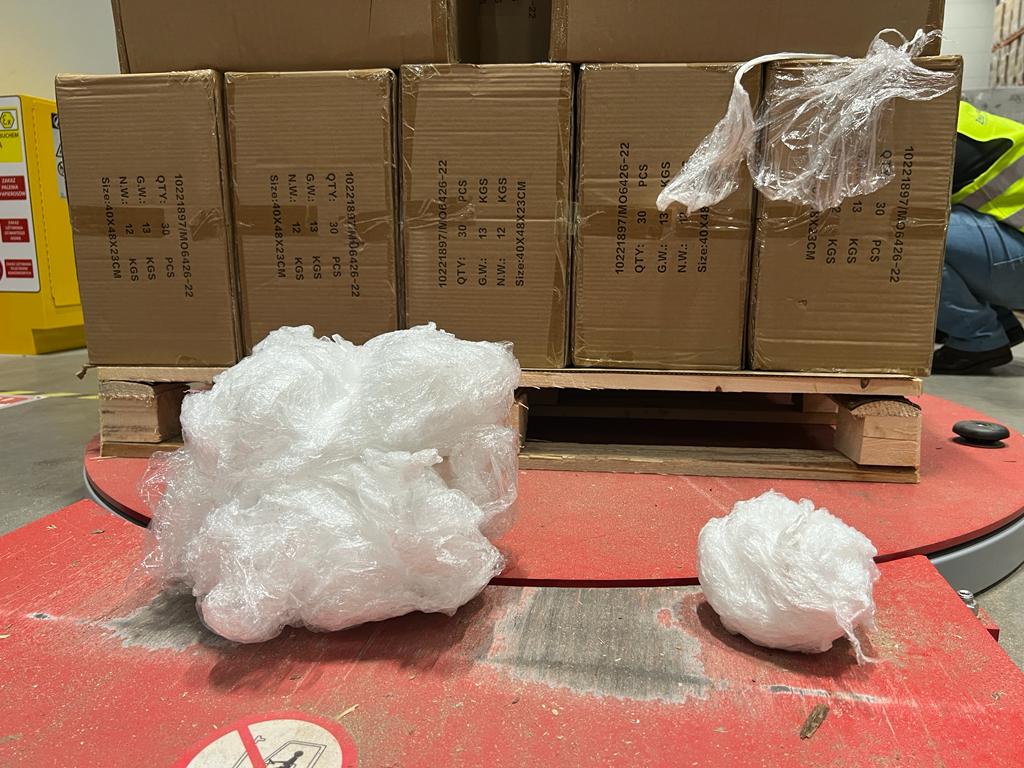
How can you reduce stretch film consumption?
Measure the starting pointCompare grams of film and film cost per pallet for equivalent loads.
Match the whole processCheck the film, carriage capabilities and wrapping programme together.
Verify load protectionAny saving must preserve the required load stability.
Assess your process
We can visit your site and propose alternatives.
Want to find out whether you use more stretch film than necessary? We can review the current wrapping process at your site and propose materials and settings to compare. The timing, location, scope and any costs of the visit are agreed in advance.
Assess the current workstation
We review load types, the film, wrapper configuration, programmes and operator practices. We identify film breaks, excessive material use and stability problems.
Trial alternative films
We propose materials matched to the machine and goods, comparing thickness, mechanical properties and stretch capability. A thinner film is suitable only when trials confirm the required protection.
Adjust and compare
We select available pre-stretch, tension, overlap and wrap-count settings, then compare film use and load protection on representative pallets.
Recommend the next steps
We explain whether the potential lies in the film and settings or whether machine equipment is the limiting factor. Where justified by the process, we propose an appropriate POLPACK ZEUS wrapper configuration.
Step-by-step settings
What should you adjust on a pallet wrapper?
There is no single set of settings for every pallet. Start with the machine instructions, film properties and the behaviour of the load during trials.
Film threading and machine condition
Check roll installation and the film path through the carriage. Dirty or worn components can reduce repeatability. Follow the machine instructions and safe-stop procedures for adjustments or maintenance; use the service team when faults occur.
Pre-stretch and film tension
Pre-stretch elongates the film between rollers before it reaches the pallet. Film tension is the force applied as film is laid onto the load. Excessive tension can deform packs; insufficient tension may not provide the required containment.
Bottom and top wraps
Select reinforcement and the connection between load and pallet for the product. Load weight alone does not determine the number of wraps: shape, packaging rigidity and transport conditions also matter.
Overlap and layers
Carriage speed relative to rotation affects the overlap between film bands. Check coverage over the full height, and remove unnecessary layers only after confirming adequate protection.
Speed and load stabilisation
Match speed to pallet dimensions and stability. Tall or lightweight loads may require a top press or other securing arrangement. Increasing speed alone does not establish a better process.
Save and monitor the programme
After successful trials, save the programme for that load group. Monitor grams of film per pallet, film breaks and protection quality. Reassess after changing film, packaging or the arrangement of goods.
Material matched to the process
How do you select stretch film for a pallet wrapper?
Thickness in micrometres and price per kilogram tell only part of the story. What matters is how the film behaves on the machine and how much material is needed to protect the pallet effectively.
| What to compare | What to check in trials |
|---|---|
| Film type | For machine wrapping, choose machine film suitable for the threading and stretching system. Assess hand film in relation to a manual wrapping process. |
| Stretch capability | Match the film to the carriage’s actual pre-stretch. A declared 250% or 300% stretch capability does not mean every machine can use that ratio. |
| Thickness and strength | Compare puncture resistance, tear resistance and behaviour around corners. Lower thickness can reduce consumption when the film properties meet the load requirements. |
| Storage conditions | Consider temperature, storage duration and location. For outdoor exposure, establish UV-protection needs and the requirements for the complete package. |
| Performance on the pallet | Compare film weight, cost, breaks and stability. Using less material alone does not prove that the load is adequately protected for transport. |
Explore our stretch film range (Polish) and discuss materials for trials.
Made in Poland / Wrapper pallet wrappers
Our pallet wrappers can reduce film consumption.
A repeatable wrapping programme and suitable film system help control the material applied to each pallet. Motorised pre-stretch makes use of the selected film's properties, while independent tension adjustment helps match the wrapping force to sensitive products.
The adjustment range depends on the model and equipment. We assess what can be improved on your existing machine first. If its capabilities limit film use or repeatability, we can demonstrate an appropriately equipped wrapper.
- Wrapper SE pallet wrapper: mechanical friction brake or optional electromagnetic brake; no powered pre-stretch.
- Wrapper SA pallet wrapper: brake-based systems or optional single-motor pre-stretch with a fixed ratio selected for the application and independent tension adjustment.
- Wrapper E EVOLUTION pallet wrapper: two-motor pre-stretch, continuously adjustable up to 300%, with independent film tension.
- Wrapper VO automatic pallet wrapping lines: automatic film handling and integration with pallet transport; configuration selected for the process.
A pre-stretch percentage is a machine parameter, not a guaranteed percentage saving.
Compare pallet wrapping solutions ↗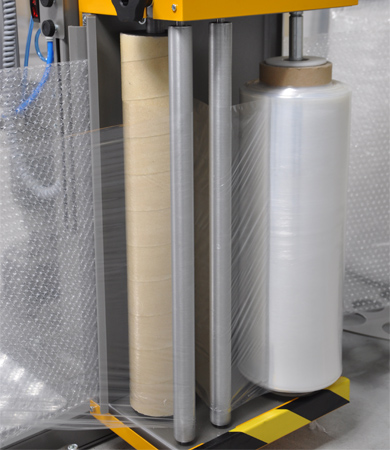
Calculate the result per pallet
How do you measure savings?
Compare several repeatable cycles for the same load group. Weighing the film roll before and after a trial establishes consumption. Include process waste, divide by the number of pallets and record the net price per kilogram of each tested material.
Illustrative calculation, not a measured installation result: 300 g ÷ 1,000 × PLN 8/kg = PLN 2.40 per pallet. After the change: 200 g ÷ 1,000 × PLN 10/kg = PLN 2.00. Film weight falls by about 33%, while film cost falls by about 17%, despite the higher price per kilogram.
At 1,000 such pallets per month, the difference would be PLN 400 net in film cost alone. Assess labour, energy, service and any machine purchase separately. Before adopting a lower-consumption programme, confirm that protection meets your transport requirements.
APOLLO process monitoring (Polish) may support ongoing checks, subject to compatibility with the machine configuration.
Results from our installations
Machine, film and settings: documented results.
These results concern film cost per pallet in the described installations. They show optimisation potential; the outcome for another plant is established through trials and measurement.
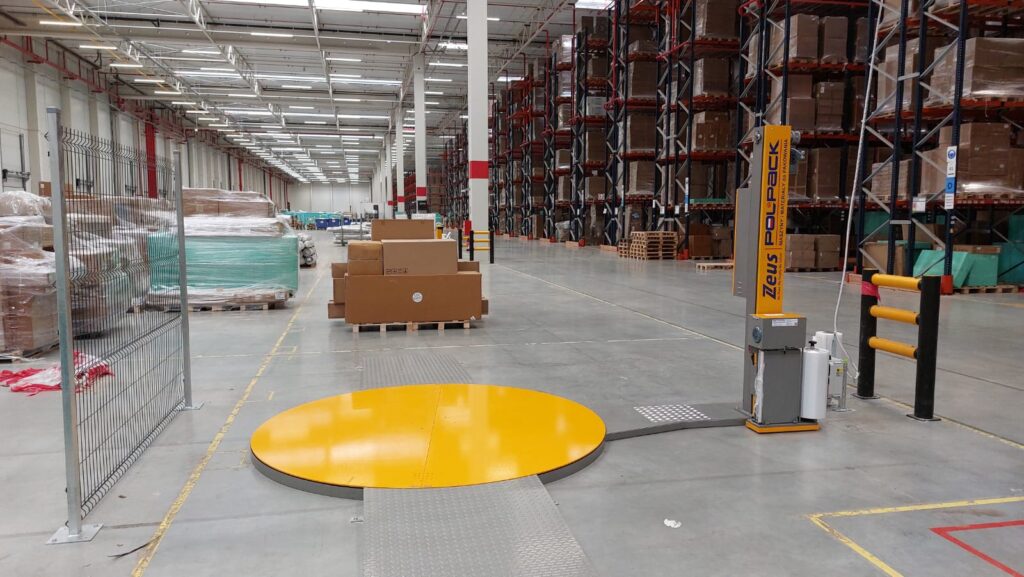
Oversized pallets: 35% lower film cost
250% motorised pre-stretch, 15 µm film replacing 23 µm film and an optimised programme. Wrapping time alone fell by more than 70% compared with manual wrapping.
Read the English case study ↗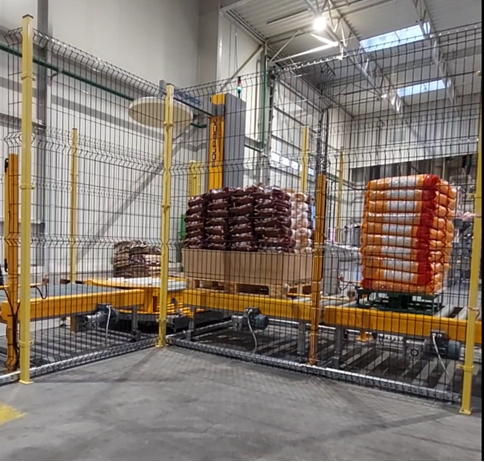
Euro and DHP pallets: 45% lower film cost
An automatic line with two-motor pre-stretch up to 300%. Film cost fell from PLN 2.85 to approximately PLN 1.57 per pallet.
Read the English case study ↗For window production, see our Wrapper SA window-wrapping installation, with approximately 35% lower film cost per window and a 50% reduction in wrapping time.
Short answers
Stretch film optimisation questions
Do I need a new wrapper to use less film?
Not always. First check the current film, machine condition and programme. Consider replacing the machine when its capabilities limit the result or no longer suit the process.
Is thinner film always cheaper to use?
No. The amount needed to protect the pallet and the material price both matter. If a thinner film needs more layers or breaks more often, the expected saving may not appear.
How much film can an audit save?
There is no single percentage for every factory. The outcome depends on the starting process, loads, film and machine. Trials compare grams and cost per pallet while maintaining the required protection.
What should I prepare before a POLPACK ZEUS visit?
The wrapper model and equipment, current film specifications, approximate pallet volumes, load dimensions and types, and a description of the problems. Include the net film price per kilogram to compare costs.
Read next
Selection, operation and support.
Use the machine instructions when adjusting settings. See also our pallet-wrapper safety guide (Polish) and semi-automatic wrapper operating tips (Polish).
A film audit at your site
Let us check how much film your pallet needs.
We can visit your site, assess the current process and propose alternative films and settings. If a different machine is justified, we will select a configuration for your loads and required output. Contact us to agree the scope and practical arrangements.
Arrange a discussion with our team ↗POLPACK ZEUS
Bukowiecka 75, Warsaw, Poland
Machine service: +48 608 689 764serwis@polpack.pl